An 86-acre living museum devoted to California native plants.
Location
1500 N College Ave, Claremont, CA, 91711, Claremont, Claremont, Los Angeles
California Botanic Garden is worth a dedicated trip for anyone interested in California native plants, ecological gardening, botany, landscape design, or regional natural history. It is a large living museum rather than a compact demonstration garden, so plan to explore part of it well instead of racing through the entire property.
California Botanic Garden is the largest botanic garden devoted exclusively to California native plants. Its 86 acres contain more than 22,000 living plants representing approximately 1,170 taxa, with collections ranging from mature woodland trees and chaparral shrubs to desert plants, native succulents, rare species, and garden-scale compositions.
This is not a compact demonstration garden that can be understood in fifteen minutes. It is a large, walkable landscape where visitors can compare individual species, see what native plants become at maturity, and move through planted environments representing different parts of California.
It is worth making a special trip, particularly for gardeners, photographers, naturalists, and anyone trying to move beyond the vague category of drought-tolerant landscaping toward a more ecological understanding of Southern California gardens.
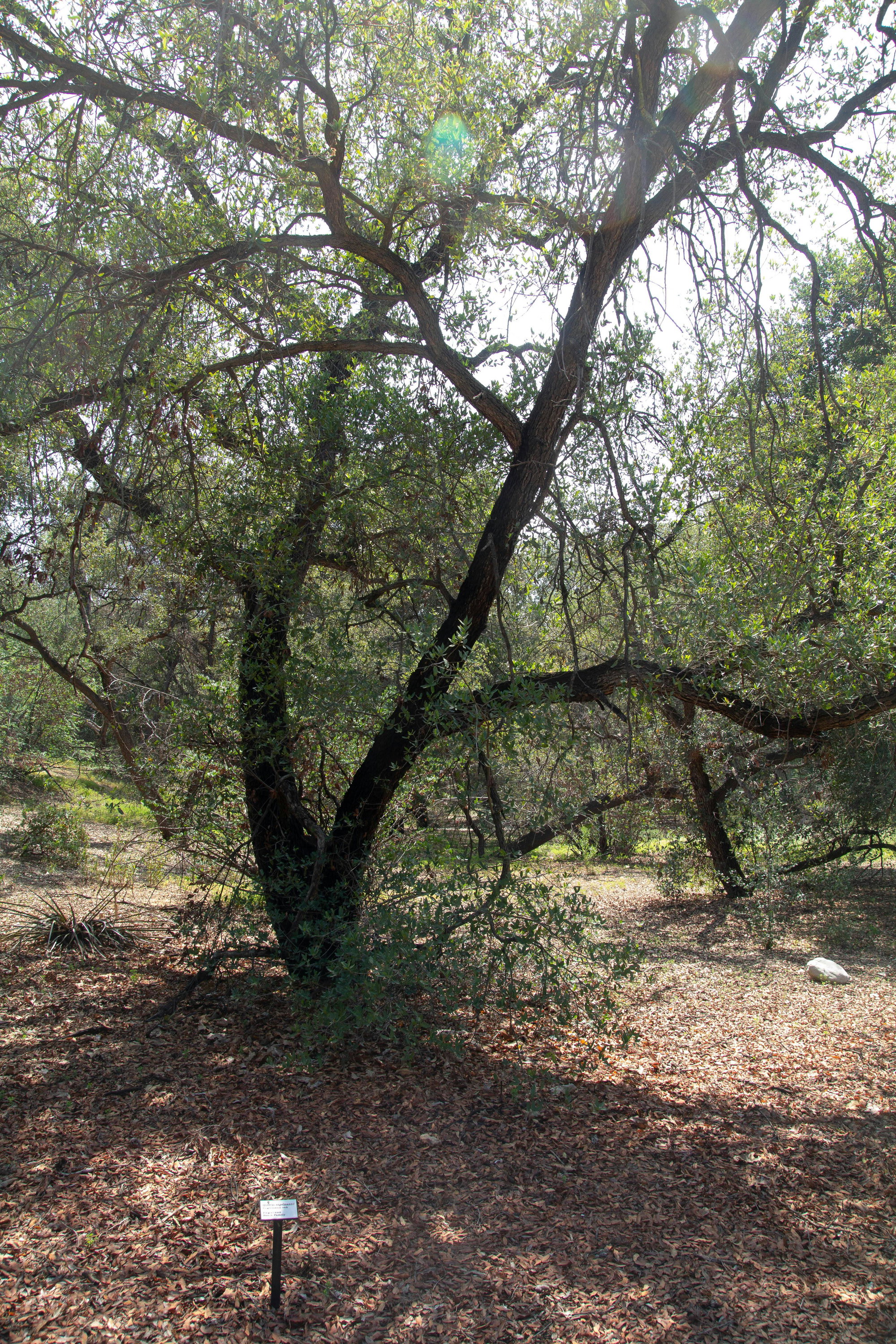
A mature native tree creates a cool woodland room beneath its spreading canopy. The leaf litter and layered understory contrast with the garden’s more exposed chaparral and desert landscapes.
The place
California Botanic Garden is simultaneously a public garden, living museum, botanical research institution, conservation organization, and graduate education center. It is privately operated as a nonprofit rather than maintained as a municipal recreation park.
The visitor experience is spread across an extensive network of paths connecting open sunny landscapes, mature woodland, chaparral-like planting, desert collections, rocky gardens, alluvial areas, horticultural displays, and more formally composed garden spaces.
The scale changes what the garden can teach. Some areas allow visitors to inspect individual labeled specimens. Others emphasize the structure of entire plant communities. Mature plants—especially trees and large shrubs—show forms that are rarely visible in nursery containers or recently installed home landscapes.
History
The garden began in 1927 on 200 acres of Susanna Bixby Bryant's Santa Ana Canyon Ranch near Yorba Linda. Bryant created it to preserve and cultivate appreciation for California's native flora and worked with leading botanists and native-plant advocates while personally directing much of its development.
The original garden endured recurring problems. A devastating wildfire swept through the property in 1943, and intense winter rain then caused landslides and erosion. After Bryant's unexpected death in 1946, the trustees appointed botanist Philip A. Munz as director. Munz was concerned that the ranch site might not remain permanently available, wanted a location that was easier to reach, and sought an affiliation with higher education. He arranged the move to Claremont, where plants and seeds from the original garden were transferred to the Indian Hill Mesa site in 1951.
The relocation was therefore not simply the result of one fire. It followed repeated damage at the old property, Bryant's death and the resulting leadership transition, concerns about the site's future, and Munz's plan for a more accessible and institutionally connected botanic garden.
What to see
Do not focus only on whichever plants happen to be flowering. Many of the garden's strongest subjects are the forms of mature California plants: smooth and twisting manzanita trunks, broad oak canopies, California sycamores, silvery dudleya rosettes, dry thistle heads, seed structures, layered chaparral shrubs, woodland understories, and plants growing around boulders and drainage features.
The garden is particularly useful for seeing how large native shrubs become when allowed enough space and time. Plants that appear modest in a nursery container can eventually function as trees, screens, shade structures, habitat, or the visual center of an entire landscape.
Also look for plant labels, transitions between shaded and exposed landscapes, plant-community displays, research collections, and temporary sculpture or exhibitions integrated into the grounds.
Field notes
My photographs from a July 2021 visit show two contrasting versions of the garden. Some portions were bright, exposed, and dry, with boulders, grasses, shrubs, succulent foliage, and plants displaying their summer structure rather than abundant flowers. Other areas were deeply shaded beneath mature trees and felt more like woodland than a conventional botanical display.
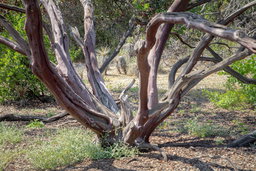
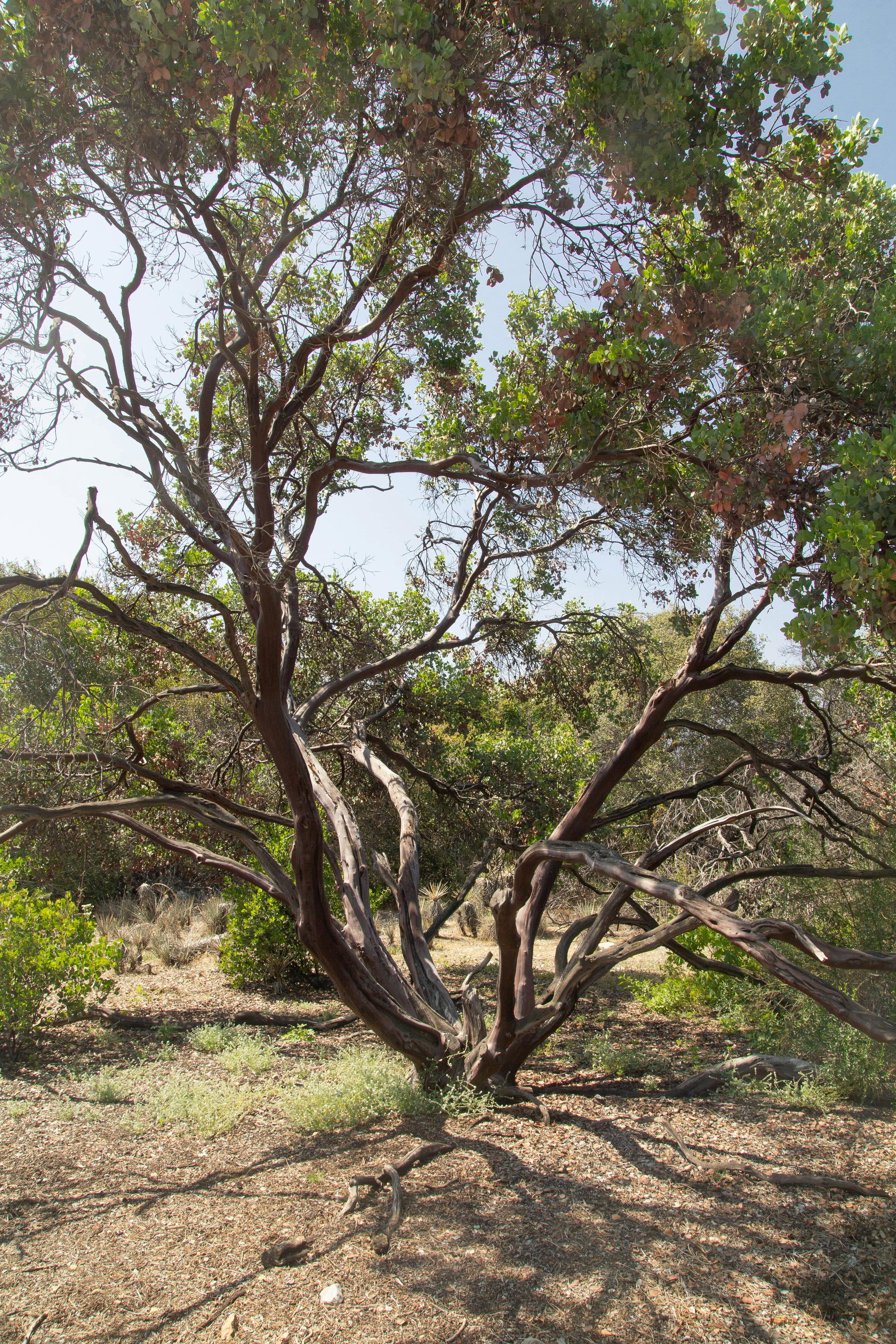
The most memorable plant was a broad, multi-trunk manzanita with smooth reddish bark and branches extending almost horizontally through the landscape. It demonstrated something difficult to understand from nursery plants: a manzanita can become the structural center of a garden rather than merely an attractive flowering shrub.
Temporary ceramic sculpture was installed among the plants during the visit. Because exhibitions change, that artwork belongs to the 2021 field record rather than the garden's permanent description.
Native plants
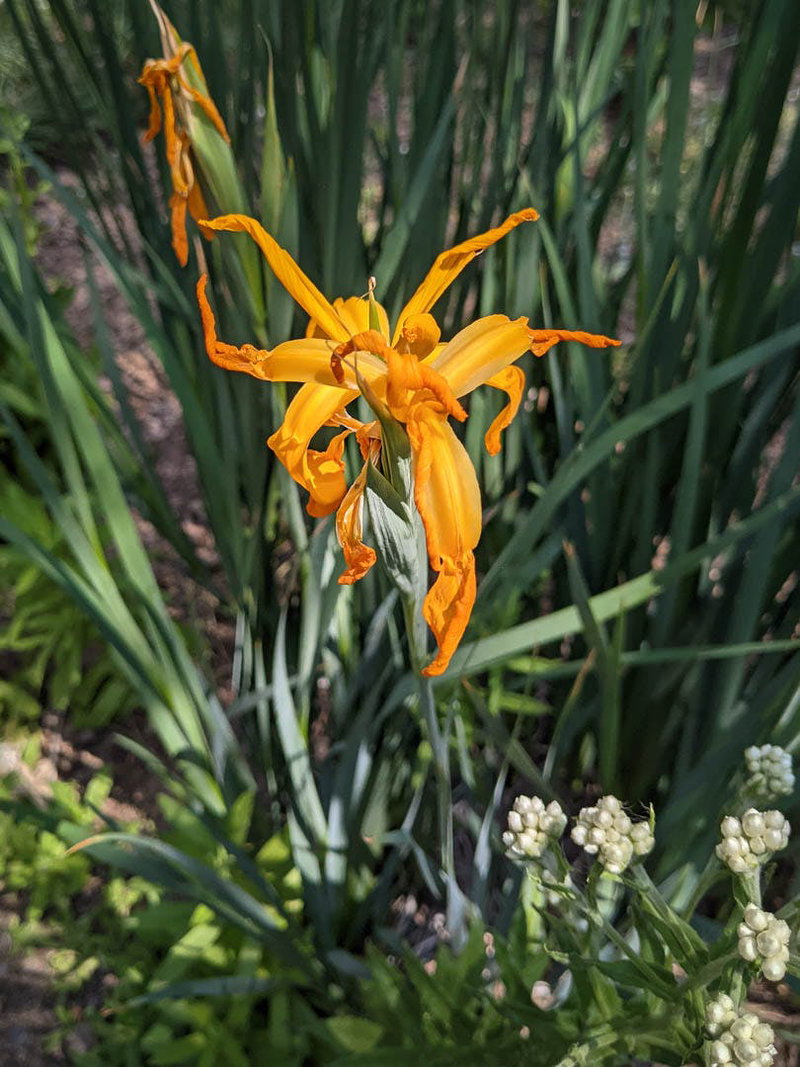
The July 2021 photographs document a mature manzanita identified confidently to the genus Arctostaphylos, an Engelmann oak identified in the legacy photo metadata, native cobweb thistles, dudleya rosettes, and purple and orange irises. Exact species or cultivar names should be used only where a plant label or accession record confirms them.
The images are seasonal observations, not a complete inventory. They are most useful for showing mature structure, dry-season form, bark, seed heads, foliage, and the contrast among plant communities.
Garden design
The garden's strongest design lesson is that a native garden does not have one visual style. California native landscapes can be shaded and woodland-like, rocky and sparse, dense and chaparral-like, meadow-like, organized around large shrubs, or composed as an ornamental garden.
The mature manzanita shows the value of giving a structural shrub enough room to develop its natural architecture. Smooth red bark, pale trunks, contorted branches, and evergreen foliage can provide interest when little is flowering.
The strongest landscapes combine canopy, medium shrubs, low plants, leaf litter, rocks, and open ground. Dry flower stalks, seed heads, summer dormancy, and restrained growth are allowed to remain part of the seasonal composition rather than being treated as automatic maintenance failures.
Mature canopy also functions as infrastructure in an inland climate, creating cooler garden rooms as well as habitat.
A broad, multi-trunk manzanita spreads through the native garden, its branching form functioning almost like a small tree. The plant’s mature architecture was one of the most memorable sights from the visit.
Wildlife
The garden functions as wildlife habitat as well as a plant collection. Mature canopy, dense shrub cover, leaf litter, flowering plants, seed heads, open ground, and sheltered spaces provide multiple habitat layers.
The 2021 photographs do not document a specific animal encounter, so the page should not promise particular wildlife sightings.
Photography
The strongest photographic subjects include mature trunks and branching structures, bark texture, flowers, succulent rosettes, seed heads, plant labels, sculpture, and the contrast between woodland and dry open landscapes.
Midday summer light creates difficult contrast. Exposed rocks and paths can become extremely bright while woodland areas fall into deep shadow. Morning or late-afternoon light should better reveal the form of mature trees and reduce blown highlights.
Visiting with kids
The garden is appropriate for children who can handle a substantial walk and do not require playground equipment to remain engaged. Unusual trees and bark, flowers, seeds, lizards, birds, insects, boulders, intersecting paths, labels, and temporary art can all provide points of interest.
The main constraints are heat, walking distance, and the need to remain on paths. Treat the visit as exploration rather than an attempt to inspect every collection. Choose one or two areas and leave something for another visit.
Home garden takeaways
California Botanic Garden answers questions that nursery displays often cannot: how large a plant becomes, what it looks like outside its flowering season, whether it creates meaningful shade, what its bark looks like after decades, and which plants belong beneath or around it.
Photograph whole plants and their surrounding space—not just flowers—and record labels whenever possible. The most useful study images show mature size, neighboring plants, ground treatment, and the relationship to paths or structures.
Before you go
The entrance is on North College Avenue north of Foothill Boulevard. Continue into the property to the main lot and admissions kiosk rather than expecting a prominent attraction directly on Foothill.
This is a paid nonprofit botanic garden, not a municipal park. Hours vary by season, and advance tickets are recommended. Check the official website before visiting.
The grounds are large. Allow at least two hours for a first visit, use the official map, and choose several areas to prioritize. Shade varies considerably, so bring water and visit early during hot weather.
Pets are not allowed except for trained service animals. Most areas are accessible, but terrain makes some routes more challenging. The garden has benches and designated picnic tables but is not organized as a lawn-and-playground recreation park.