
Public Park

Cougar Park

A neighborhood park, a guarded community garden, and a small window into Covina's citrus history.

Location

150 W Puente St, Covina, CA 91723, Covina, Covina, Los Angeles

A minor but worthwhile stop for seeing a working neighborhood garden and the way Covina remembers its citrus past.

Open directions →
Community Garden Behind the Fence

Overview

Cougar Park is a small neighborhood park in Covina with a playground, community center, and community garden. The garden is what brought me here.

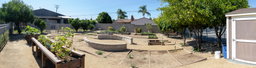
The community garden is not open for casual wandering, although much of it can be seen through the fence and over the low walls. The rest of Cougar Park is a public park. That distinction matters: the controlled access applies to the growing plots, not to the park as a whole.
Cougar Park Entrance Sign

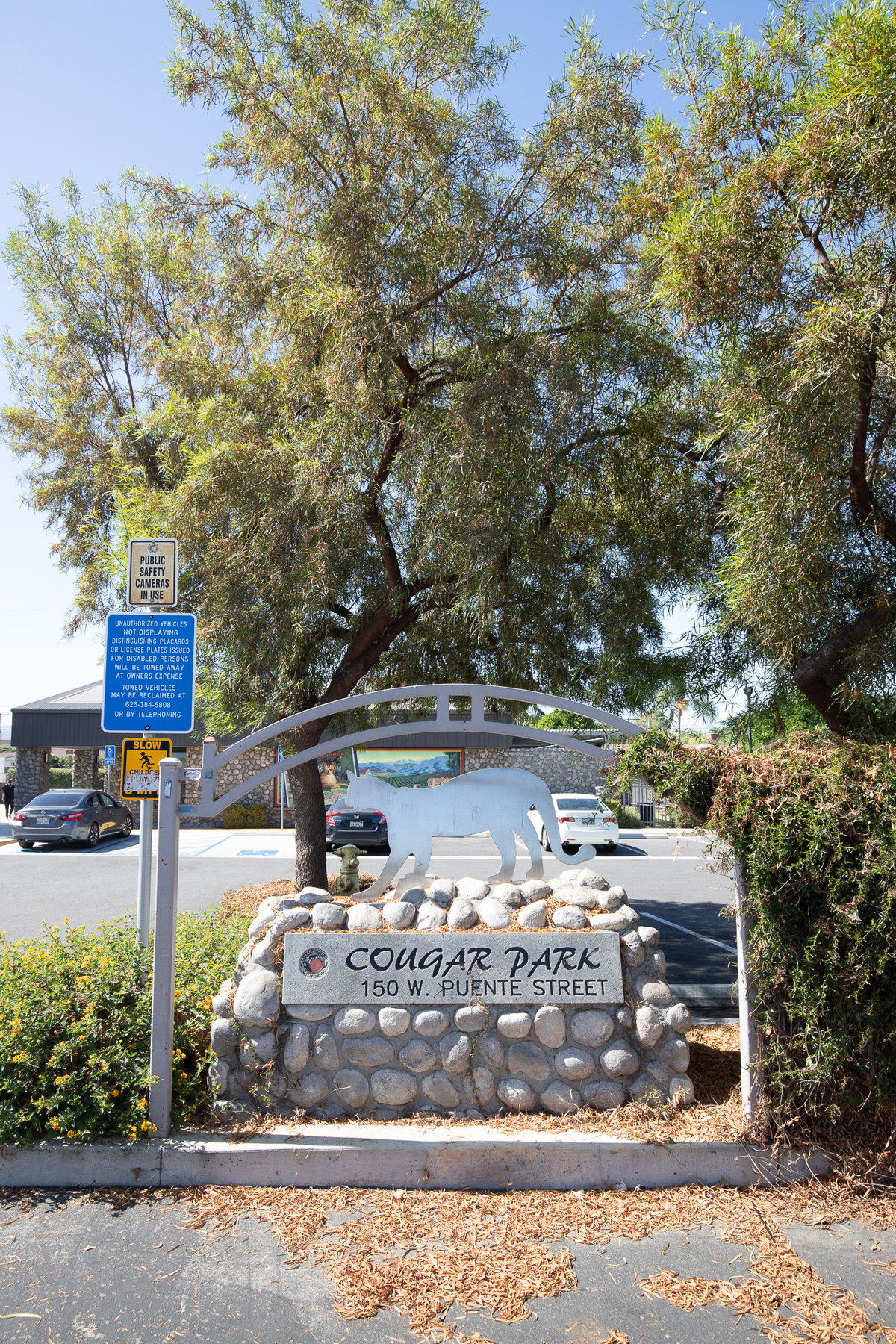
A cougar silhouette marks the entrance to Cougar Park at 150 W. Puente Street in Covina, framed by mature trees and river-rock masonry.
The place

This is primarily a municipal neighborhood park, not a garden destination. Its community garden occupies a fenced area beside the community center, with individual beds, raised planters, paths, citrus trees, and a curved central seating or gathering feature.

Community gardens are some of the most revealing public landscapes we have because they show what people actually choose to grow rather than a single designer’s finished composition. Here, that landscape can be viewed but not casually entered.

What to see

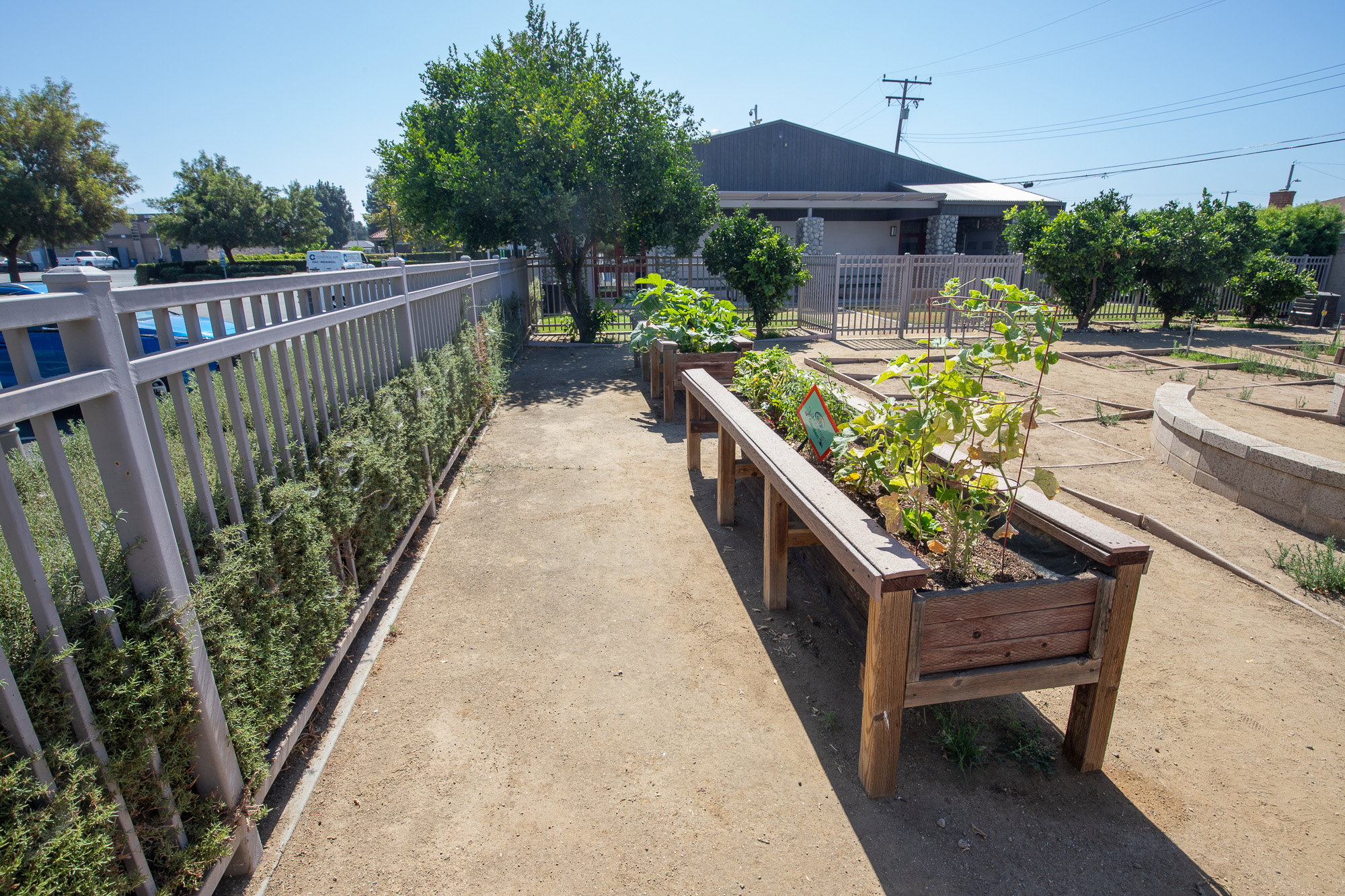
Look through the garden fence and over the walls at the contrast between the active raised beds along the edge and the more lightly used plots in the center. Squash and other vegetables were growing vigorously in several raised planters during this visit, while other beds were nearly empty.

On the community-center wall, a large mural recalls Covina’s citrus era: rows of groves run toward the mountains beside an enlarged Cougar Brand orange label. The park entrance repeats the cougar image, tying the local school-and-city symbol to the agricultural history presented on the building.

The citrus trees surrounding the garden are also part of the story. They are not remnants of a native ecosystem, but they are living reminders of the crop that transformed Covina and much of the San Gabriel Valley.

Field notes

The garden was showing its age when I visited. Several plots were nearly empty during a season when they could have been full, and the paths and central area felt a little worn. Still, it would be unfair to stop there. The raised beds along the edge were green and productive, and the surrounding citrus trees and established plantings were clearly being cared for.

I find the limited access a little disappointing. I would like to be able to walk through a community garden and see what people are growing. But I also understand why the plots are protected. Some visitors interpret the word community as permission to pick produce that belongs to an individual gardener.

Cougar Park is a minor stop, but it gathers several versions of the San Gabriel Valley into one small place: the ordinary neighborhood park, the guarded growing space, the memory of the orange groves, and the present-day city trying to keep that memory visible.


Raised Beds at Cougar Park

A closer view of the community garden shows a mix of productive beds, empty spaces, irrigation lines, and established plantings around the perimeter.

Native plants

The citrus imagery at Cougar Park is a useful opening for talking about what came before the orchards. The San Gabriel Valley was not empty land, and it was not simply desert. Before intensive agriculture and urbanization, the landscape changed across soils and drainage patterns: coastal sage scrub, chaparral, oak woodland, grassland, and broad alluvial washes carried water and sediment out of the San Gabriel Mountains.

Scrub oaks and larger live oaks offered shade and shelter. Sages, buckwheats, currants, toyon, elderberry, and other drought-adapted plants fed birds, insects, and mammals. Seasonal water moved through sandy channels, while deeper-rooted trees gathered where moisture lingered.

It was a living landscape shaped by fire, flood, drought, wildlife, and generations of Indigenous care. There was habitat here before citrus, and there is still room for habitat now—in parks, gardens, schoolyards, street plantings, and the overlooked spaces between buildings.

Garden design

The community garden is organized plainly and practically: narrow plots laid out in a grid, taller raised planters along one side, citrus around the perimeter, and a low curved wall near the center. The controlled enclosure protects the plots while still allowing passersby to see much of the space.

The mural gives the garden a wider frame. Instead of treating food growing as an isolated hobby, the site connects today’s small plots to the much larger agricultural landscape that once surrounded Covina.

Wildlife

The community garden and citrus trees can provide food, flowers, cover, and perching opportunities in a neighborhood otherwise dominated by houses, pavement, and clipped landscaping. Its habitat value depends on what is in active cultivation and how the surrounding beds are maintained.

The larger lesson is that productive gardens and habitat do not have to be opposites. Edible plants can be combined with native flowering shrubs, buckwheats, sages, groundcovers, and small trees that support insects and birds.

Photography

The strongest photographs place the community garden in context: the full panorama of plots, productive raised beds against emptier ground, the citrus trees, the Cougar Brand mural, and the park entrance sign.

The fence and walls limit angles, so wider lenses and careful framing are useful. Midday light is harsh and reflective; morning or late-afternoon light would better reveal the beds and mural.

Visiting with kids

The public park offers play equipment and a splash pad, while the garden provides a chance to look at vegetables and talk about where food comes from. Children should view the community garden from outside the controlled area unless they are participating through an authorized program.

The mural also supports a useful local-history conversation: ask what the valley looked like during the citrus era, then ask what was here before the groves. The answer is not empty desert, but a varied native landscape with oaks, scrub, washes, wildlife, and human stewardship.

Home garden takeaways

Citrus was introduced agriculture, but it remains one of the most useful things a Southern California homeowner can grow. Lemons perform exceptionally well in this climate, and a productive tree can replace an astonishing number of grocery-store purchases. With lemons outside the door, bottled dressing becomes optional; often a squeeze of lemon can do the work of vinegar.

That does not mean recreating an orchard or ignoring current pest and disease problems. A more complete home landscape can hold both histories: a well-sited citrus tree for food and cultural continuity, and native plants that restore some of the habitat and seasonal character of the valley.

The community garden also shows the importance of participation. Empty beds are not a design failure so much as evidence that gardens depend on people, time, access, and sustained institutional support.

Before you go

Cougar Park is at 150 West Puente Street in Covina. The City of Covina lists parking, picnic tables, play equipment, a splash pad, exercise equipment, a community center, restrooms, and the community garden among its amenities.

The park itself is public. The community garden is a controlled-access area and should be viewed from outside unless you have authorized access.

This is a brief neighborhood stop rather than a major garden destination. The mural and garden are close together and can be understood in a short visit.

Photos

See the photo gallery.

View gallery

Location

Where to find Cougar Park

150 W Puente St, Covina, CA 91723, Covina, Covina, Los Angeles

View map