
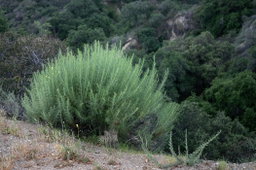
California sagebrush (Artemisia californica) is one of the plants that makes Southern California look and smell like Southern California. Its fine gray-green foliage, loose branching, and unmistakable resinous fragrance are characteristic of coastal sage scrub—the low, drought-adapted shrubland that once covered broad areas of our coastal plains, foothills, and inland valleys.
Despite its common name, California sagebrush is not a true sage. True sages such as white sage and black sage belong to the mint family (Lamiaceae). California sagebrush belongs to the sunflower family (Asteraceae), alongside daisies, sunflowers, and goldenrods. It is called “sagebrush” because its aromatic foliage reminded people of sage. Its close relatives in the genus Artemisia include mugwort, wormwood, tarragon, and the big sagebrushes of the interior West.
A defining plant of coastal sage scrub
California sagebrush is more than a plant that happens to occur in coastal sage scrub. It is frequently one of the community’s dominant or identifying species. In many places it grows with California buckwheat, white sage, black sage, deerweed, brittlebush, coyote brush, lemonade berry, prickly pear, and native grasses. The “sage” in the name coastal sage scrub refers to this broader group of aromatic shrubs, including both Artemisia and Salvia.
This distinction matters because coastal sage scrub is not simply a shorter version of chaparral. It is generally more open, lower-growing, and strongly shaped by summer drought. Many of its shrubs reduce their leaf area, become partly dormant, or look brown and sparse during the driest part of the year. California sagebrush is especially well adapted to this rhythm.
What California sagebrush looks like
California sagebrush usually forms a rounded or irregular shrub about 2 to 5 feet tall, often spreading at least as wide. Several stems rise from a woody base and divide into a fine framework of flexible branches. With age—and with selective pruning—the plant can develop an attractive, windswept skeleton that looks more sculptural than tidy.
The leaves are narrow, soft, and deeply divided into threadlike segments. Their color ranges from gray-green to silvery green, depending on season, exposure, and moisture. Crushing or brushing the foliage releases a powerful fragrance that may seem herbal, sharp, resinous, or almost medicinal. For many Southern Californians, it is the smell of a dry foothill trail after rain.
The flowers are small and easy to overlook. Tiny yellowish to brownish flower heads appear in branching clusters, most often from late summer into fall, although flowering time varies with location and rainfall. California sagebrush is wind-pollinated, so it does not advertise itself with the large, colorful flowers associated with insect-pollinated garden plants.
Evergreen—or drought-deciduous?
California sagebrush often carries foliage throughout the year, but it is more accurately described as drought-deciduous or seasonally semi-deciduous. During the cool rainy season it produces larger leaves and active new growth. As the soil dries, it sheds some of that foliage and retains smaller dry-season leaves. In a severe drought, portions of the plant may become bare or die back.
This summer thinning is a survival strategy, not necessarily a sign that the plant is failing. Leaf loss reduces water demand until shorter days, cooler temperatures, and winter rain allow growth to resume. A garden designed around Southern California’s natural seasons should make room for this change rather than expecting every plant to remain lush in August.
Ecological value
California sagebrush creates habitat through its entire structure. Its fine branches provide cover and nesting opportunities; its foliage supports a diverse community of arthropods; and its seeds and associated insects feed wildlife. The U.S. Forest Service notes especially strong relationships with birds of coastal sage scrub, including the California gnatcatcher and Bell’s sage sparrow.
Its ecological role cannot be reduced to how many visible bees visit its flowers. Because it is wind-pollinated, California sagebrush may look less active than a flowering buckwheat or sage. Yet it helps create the physical and biological framework in which a coastal sage scrub community functions. It supplies shelter, supports food webs, shades the soil, contributes litter, and helps native shrubland recover on disturbed ground.
California sagebrush can regenerate from seed and may resprout from the root crown after damage. It is adapted to a landscape where fire occurs, but that does not mean it benefits from frequent burning. Repeated fire can kill mature plants, deplete native seed sources, and accelerate conversion of coastal sage scrub to invasive annual grassland. Its fine branching and aromatic, summer-dry foliage can also burn readily, so it should be placed according to current defensible-space guidance rather than directly against a house.
California sagebrush in the garden
In a garden, California sagebrush works best as a habitat shrub, loose informal hedge, slope plant, background mass, or textural bridge between larger shrubs and low perennials. It is particularly effective where visitors can brush against the foliage and release its scent. The pale, finely divided leaves contrast well with the broader foliage of lemonade berry, coffeeberry, toyon, or manzanita and with the stronger flower forms of buckwheat, monkeyflower, woolly bluecurls, and native mallows.
Give the species room to express its natural form. A single plant can become broad and somewhat irregular; several plants spaced as a loose colony can evoke the native landscape more convincingly than one shrub clipped into a formal ball. For a lower groundcover, named cultivars such as ‘Canyon Gray’ offer a different form, but they should not be confused with the upright habit of the wild species.
Light
Plant in full sun for the densest growth and strongest fragrance. It can tolerate some light shade, especially near the coast, but plants in too much shade may become open and floppy.
Soil
California sagebrush is adaptable to many local soils, including lean and rocky ground, provided the root zone is not kept chronically wet. It does not need rich soil or fertilizer. Excess fertility and regular irrigation can push soft, rank growth that obscures the plant’s natural structure.
Water
Planting in fall or early winter gives the roots time to establish during the rainy season. Water deeply but infrequently through the first dry season, adjusting for soil, exposure, and heat. Once established, California sagebrush can survive with little or no supplemental summer water. An occasional deep watering may keep it fuller, but frequent shallow irrigation—especially near the crown—works against its natural drought cycle and may shorten the plant’s life.
Pruning
California sagebrush can be left unpruned for a loose natural form, lightly shortened to encourage density, or selectively thinned to reveal its woody framework. Remove dead or crossing stems and cut individual branches back to living growth rather than shearing the whole plant into a uniform shape. Some summer browning is normal and should not automatically trigger more irrigation.
Traditional Indigenous uses
California sagebrush has longstanding and varied relationships with Indigenous peoples of California. Ethnobotanical records attribute medicinal, ceremonial, aromatic, and practical uses to particular communities, including the Cahuilla and Chumash. Recorded preparations include washes, poultices, decoctions, uses in sweathouses and purification practices, and branches used for tools, fire-making, windbreaks, and enclosures.
These traditions should be described specifically rather than compressed into the claim that “Native Americans used it as medicine.” Different nations had different practices, and historical records do not automatically establish that a preparation is safe or effective for modern self-treatment. California sagebrush should not be consumed or used medicinally based on a garden profile; Calflora also notes possible skin irritation from contact with the foliage.
Related plants and common confusion
- White sage and black sage: These are true sages in the genus Salvia and the mint family. Their leaves and flowers are substantially different, although they often share habitat with California sagebrush.
- California mugwort (Artemisia douglasiana): A close relative that is generally more herbaceous, greener, broader-leaved, and associated with seasonally moist places. It often spreads by underground rhizomes.
- Big sagebrush (Artemisia tridentata): The iconic sagebrush of the Great Basin and other inland western landscapes. Its leaves typically have three small teeth at the tip, and it belongs to a different ecological region.
- Wormwood and tarragon: Other members of the large and aromatic genus Artemisia. Their relationship explains the family resemblance in fragrance and foliage, but they are not interchangeable garden or medicinal plants.
Why grow it?
California sagebrush asks gardeners to value more than flowers. Its beauty comes from scent, texture, movement, seasonal change, and the life that gathers inside its branches. It belongs in Southern California gardens because it belongs to Southern California itself: not as a decorative approximation of the native landscape, but as one of the species that defines that landscape.