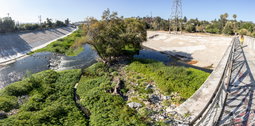
Because I wanted to see them all in one morning, we drove from one to the next. That worked, but it also made the parks feel more disconnected than they really are. After a few stops, it became clear that these are not really separate attractions. They are small pieces of the LA River bike and walking path.
That is probably the better way to experience them. Pick a stretch of the riverwalk, visit two or three parks, and turn around when you are done. The whole chain would be a lot for a casual family walk, especially on a hot day. But even a short section gives you the idea.
The parks are places to pause along the river. A bench, a bridge, a patch of shade, a planted slope, a view into the channel. They are small, but they change how you experience the river.
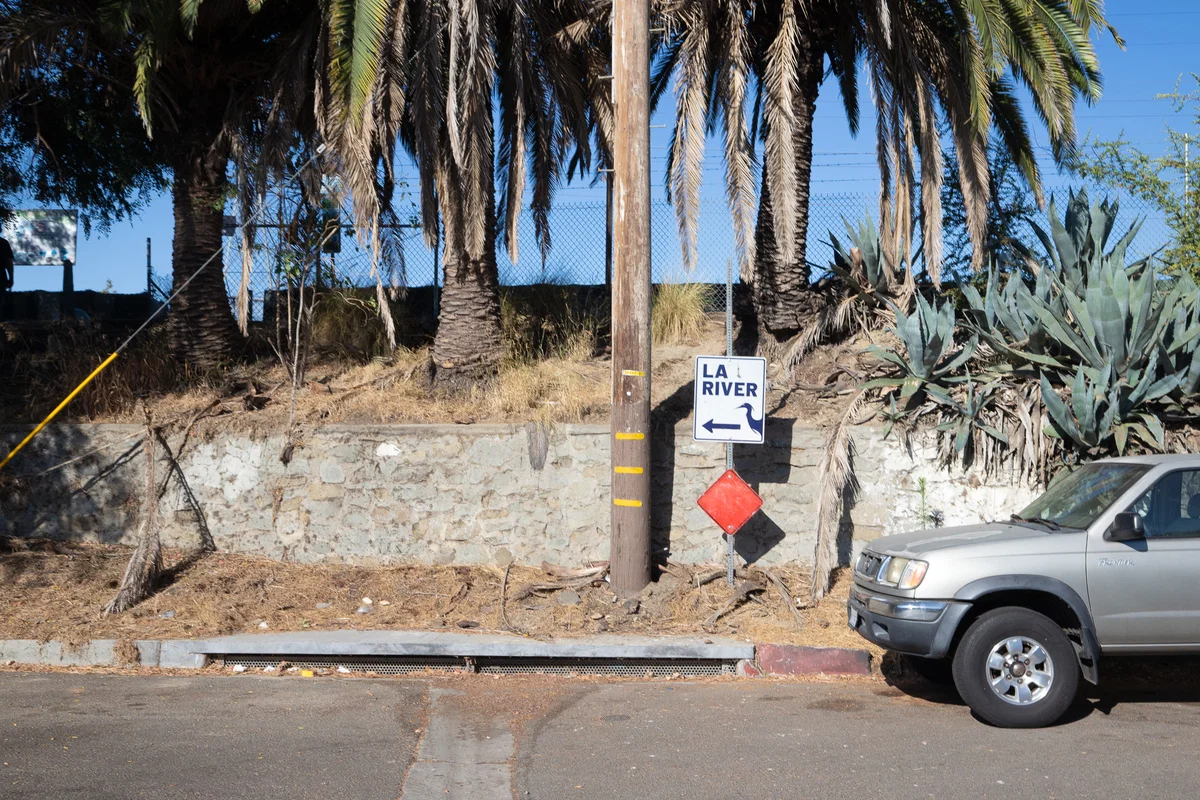
That said, walking the whole chain is a lot. Depending on where you start and end, you may be looking at several miles one way, and then you still have to get back. When I was running regularly, that would have been a normal outing. For my family, not so much.
So my practical advice is: don’t feel like you need to do the whole thing. Pick a stretch of the riverwalk. Visit two or three parks. Walk until you are done, then turn around. The river is the destination.
These parks were built as part of LA River restoration work. Not the kind of restoration where the river is magically returned to some untouched natural state. That is not really possible here. The LA River cuts through too much city. There are homes, businesses, roads, bridges, power lines, rail lines, freeways, and entire neighborhoods built around the assumption that the river will stay contained.
The LA River was famously paved through Los Angeles, turning a living river system into something closer to a giant storm drain. That is how many of us grew up understanding it. A concrete channel. A movie location. A place for car chases. An eyesore. A joke.
There is even a cocktail called an LA River named because it looks like polluted river water. The joke is obvious: the LA River is dirty, artificial, and maybe toxic. That was how many of us understood the river growing up. A concrete channel. A movie location. A place for car chases. An eyesore.
But along this stretch, especially through the Glendale Narrows, the river is not only that. There is actual water. There are trees growing in the channel. There are birds, vines, insects, and riparian plants. There are places where the river looks surprisingly alive.
That was the main thing I learned this day. The parks are good, and I am glad they exist. But the real feature is the path and the river itself.
I visited on a Monday morning, when most Angelenos were commuting to work. And then, presumably, working. Even so, the river path was being used. It was not crowded, but people were out walking, jogging, biking, roller skating, walking dogs, or just moving through the space.
That matters. A public space does not need to be packed to be working.
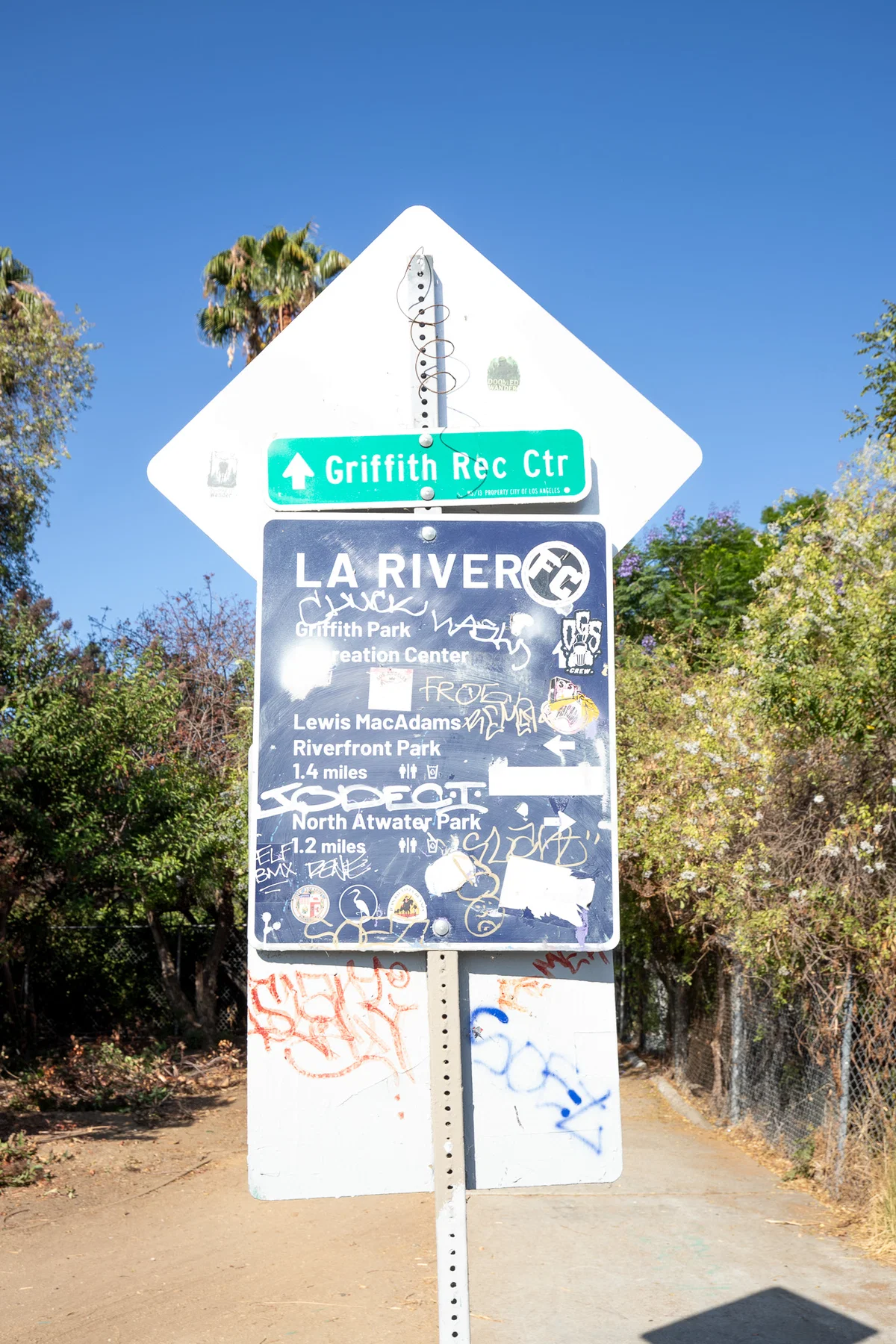
There were also signs of neglect. Some of the interpretive signs were faded, vandalized, or completely gone. There was graffiti. There were unhoused people. There was some police presence, probably related to cleanup or enforcement. I don’t want to romanticize the place or pretend it is polished from end to end.
But I also don’t want to reduce it to that.
No one bothered us. No one seemed threatening. One older unhoused woman kindly said hi. Mostly, the place felt like what it is: a complicated public corridor running through a complicated city.
And because it is public, people use it to speak.
That was one of the themes of the morning. The official signs, the restoration signs, the park names, the gates, the plaques, the graffiti, the freeway-facing protest signs, the engraved locks, the warnings about the river water, the political messages: all of them are attempts to say something in public.
Some messages are planned and permitted. Some are improvised. Some are angry. Some are funny. Some are crude. Some are beautiful. Some are just someone insisting they were there.
The parks themselves are a message too. They say the river matters. They say public access matters. They say a concrete flood channel can still be treated as a living place. They say that restoration does not have to be perfect to be worth doing.
That is also why I am sharing these photos. I am not just reviewing parks. I am trying to pass along the same message: look at this place. Notice the work people have done. Notice what still needs care. Notice that the LA River is not only a joke, not only infrastructure, not only a problem. It is also a public landscape.
Sunnynook Park
Sunnynook was the first park we visited. I had my son with me.
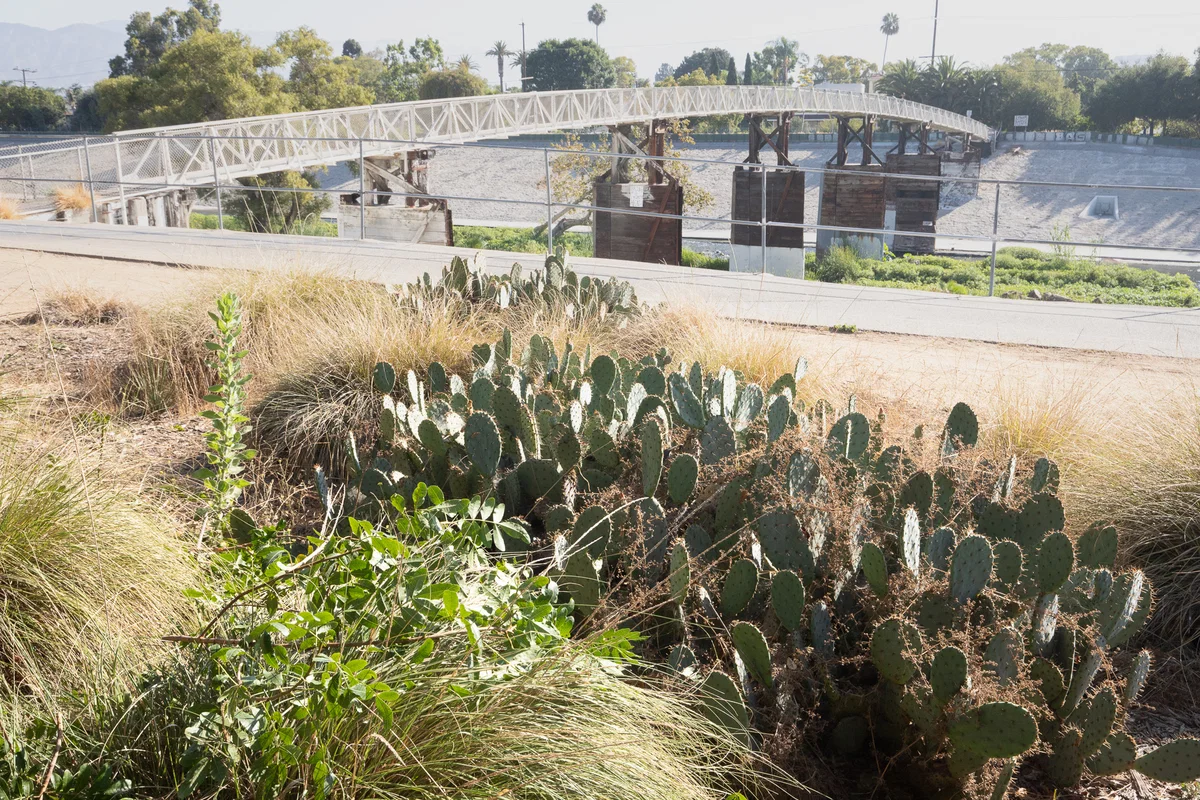
The first thing I learned is that Google Maps does not understand these parks very well. Following the driving directions took us to Bond Park, which was not a terrible starting point, but not exactly right either. Looking at the map instead of blindly following the directions got us closer. From Bond Park we took Legion Lane to Sunnynook Drive, and that intersection felt like the right starting point.
From there, a small walking path takes you up toward the riverwalk. There are steps, a pedestrian bridge, and a small sitting area. The landscaping includes Opuntia, coast live oak, and other familiar Southern California plants. From the bridge and path, you can look down at the river and see water, trees, and thick green riparian growth.
Some of the signage here is worn away or missing. That turned out to be a theme at several of the parks. They were clearly built with interpretation in mind, but the interpretive signs have not held up. In some places, the frames remain but the message is gone.
That is frustrating, but also revealing. The official message has faded. The river is still there.
Near Sunnynook, we spoke briefly with people setting up a freeway-facing sign about Mitch McConnell. I did not see the finished message, but it was something to the effect of “Where’s Mitch?”
Nearby, someone had left a cardboard sign that read, “Bring me Trump’s Head.”
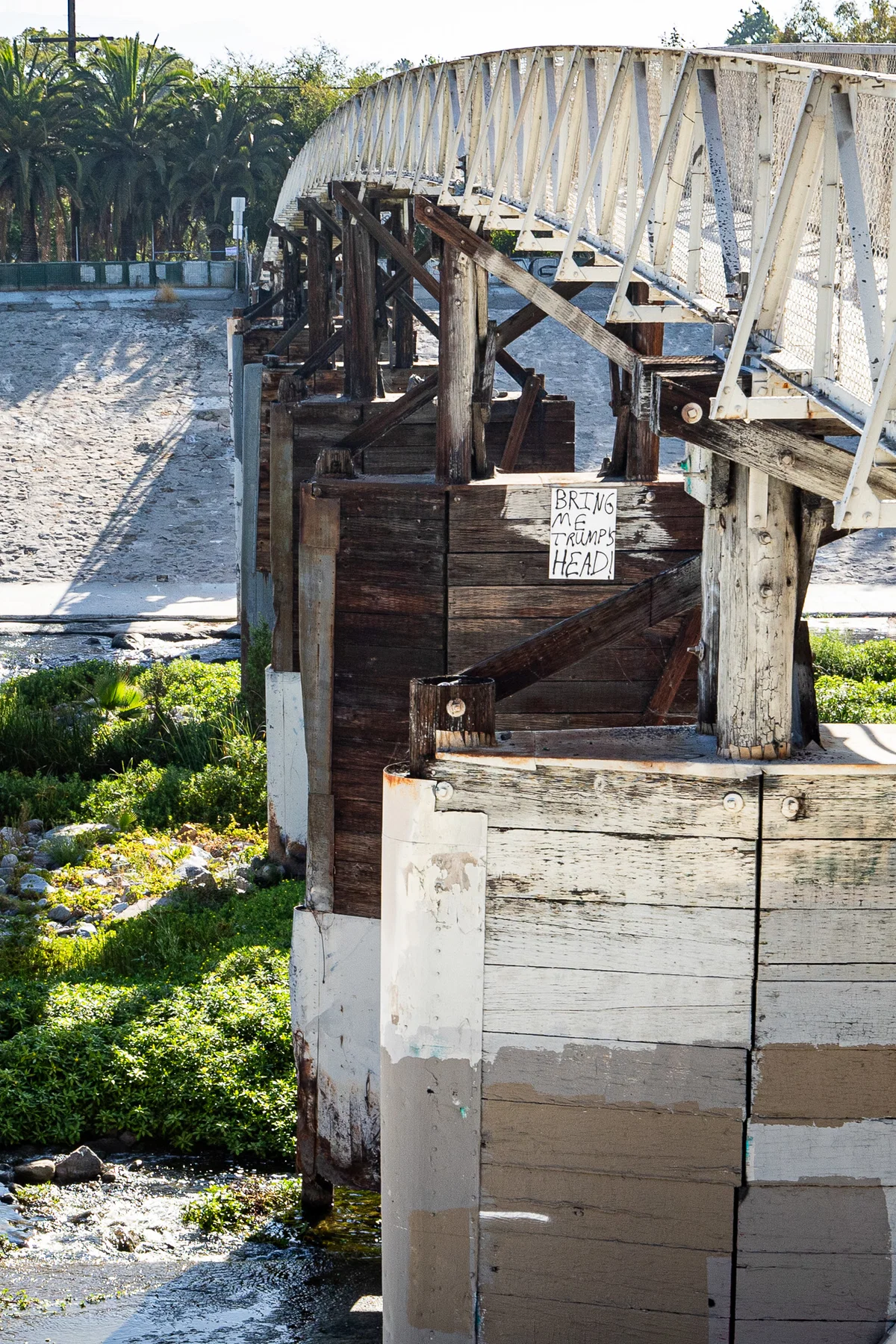
My son asked why people were putting up signs over the freeway. So I explained, as best I could, that they were activists. They did not have to be there. They chose to spend their own time making a public statement and trying to hold the government accountable.
That felt connected to what we were doing too. Not in the same way, obviously. But paying attention to the river, photographing it, writing about it, and pointing out the work people have done to restore and protect it is also a form of civic attention.
As you will see in the photos, there is a lot of graffiti along the walk. When I was a kid, graffiti always meant gross, dirty, dangerous. I don’t know if graffiti has changed or if I have. Along the river, it felt less simple than that.
We saw locks on the bridge with engraved messages. We saw signs posted over the river. We saw political messages. We saw graffiti that was just words painted in bright colors, declaring that this space does not fully belong to whatever industry or agency built the wall behind it.
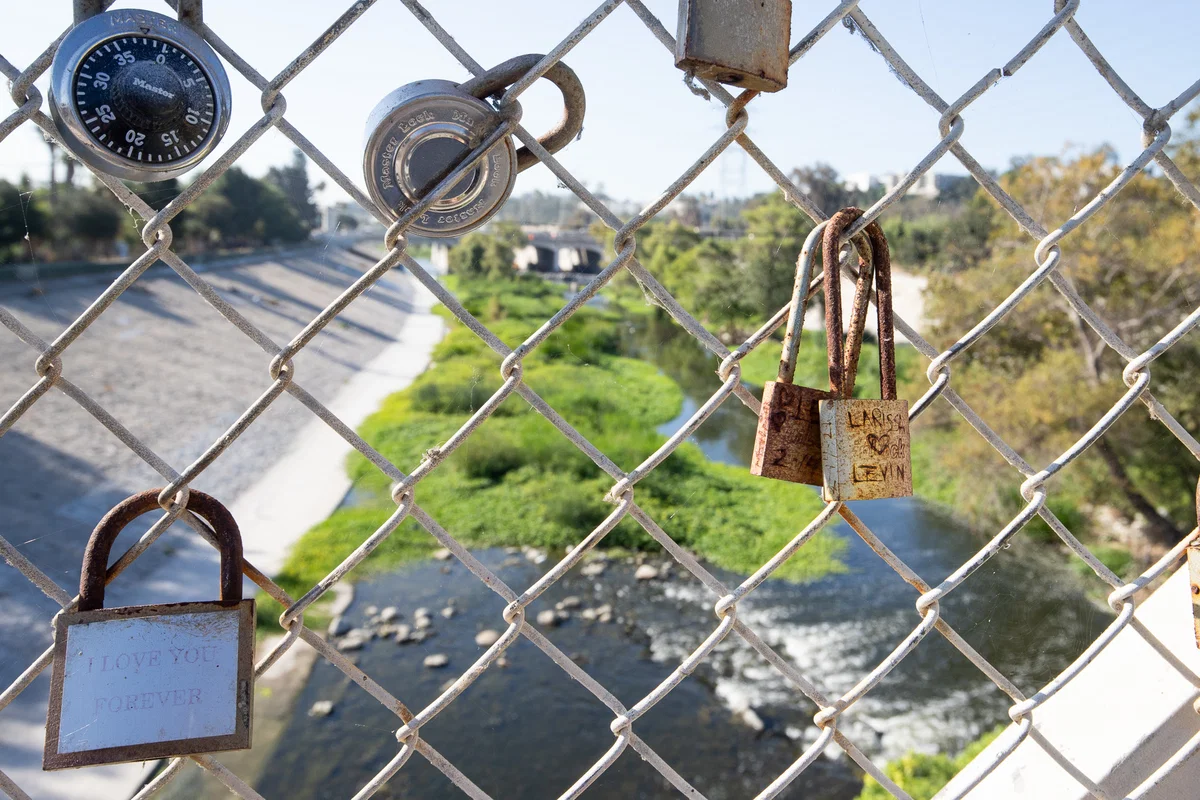
That is part of the place too.
Rattlesnake Park
The next park was Rattlesnake Park. Again, Google Maps got us most of the way there, but not exactly there. We passed Salazar, which I knew, but not as part of the river. Years ago, my wife found it and we went there for tacos when my son was about two. I remember the patio, the gravel, the industrial edges around it, and my son played with some actress my wife recognized from tv. Mostly, I remember it as one of those Frogtown places that feels tucked into an unlikely spot.
Now I was back for a completely different reason, trying to find a pocket park and the river path hidden in the same landscape. That is what made the area interesting to me. I had been there before, but I had not really seen this layer of it. The restaurant, the warehouses, the bridges, the fences, the graffiti, the park entrances, and the river itself are all interwoven.
These parks are like that too. They are there, but not quite there. Around the corner from places people already know. Easy to miss unless you are looking for them.
That became one of the themes of the day: these parks are not separate from the city around them. They are interwoven with it.
From the riverwalk, we saw the bridge to Atwater Village. It is a familiar bridge, but an unfamiliar view of it. One of the surprises of the morning was how much character the bridges have from the river path. From a car, they can feel purely utilitarian. From below or beside them, they become landmarks.
Rattlesnake Park took some searching. The path forked, with one part going down alongside the river and another heading uphill toward the bridge. I was not sure which path would lead to the park.
It turned out the park was uphill, tucked into that fork.
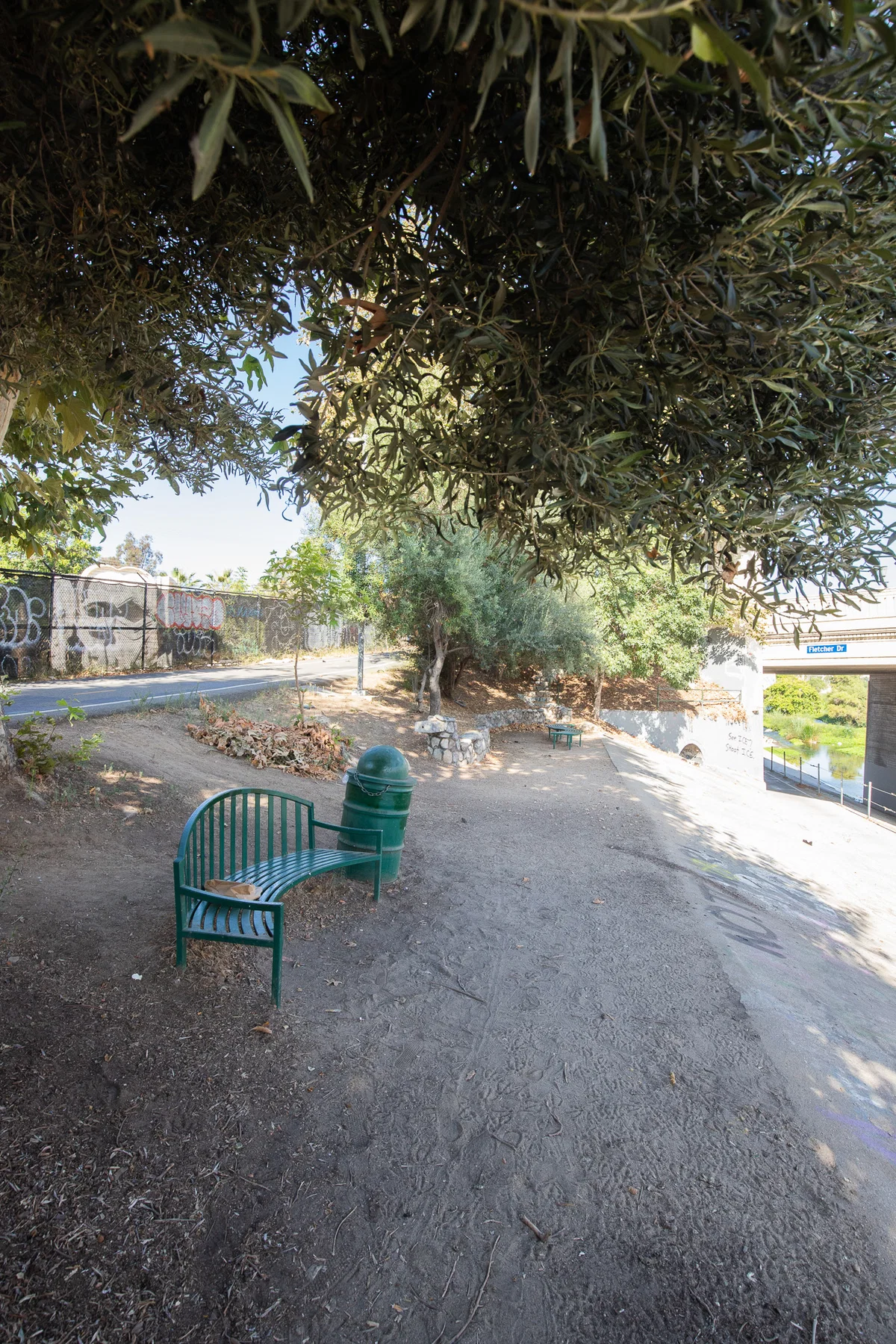
And that is really what these parks are about. They are little spaces for public enjoyment in places that otherwise might have been hot, useless pavement. Instead, there is shade, a few benches, planting, and a view of the river. One person could spend an hour there just sitting and watching the water. Even on a hot day.
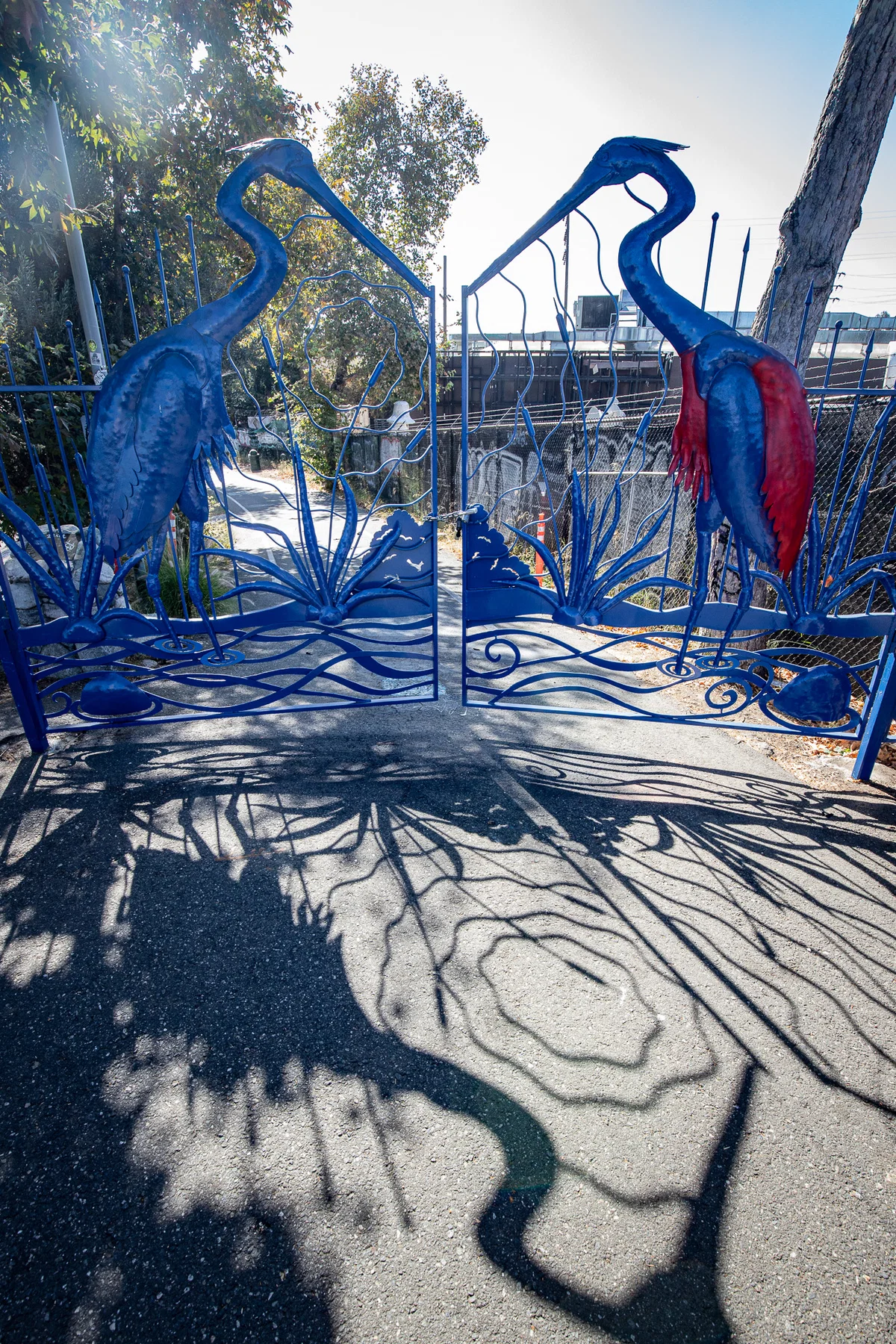
If you continue up the path, you find the Great Heron Gates, which invite people onto the river path. We had just come from the wrong direction.
That kept happening. These spaces made more sense once I stopped thinking of them as destinations and started thinking of them as part of a route.
Steelhead Park / Oso Park
Our next destination was Steelhead Park, but we ended up at Oso Park, which had most of the signage. Did I mention Google does not do a great job navigating to these parks?
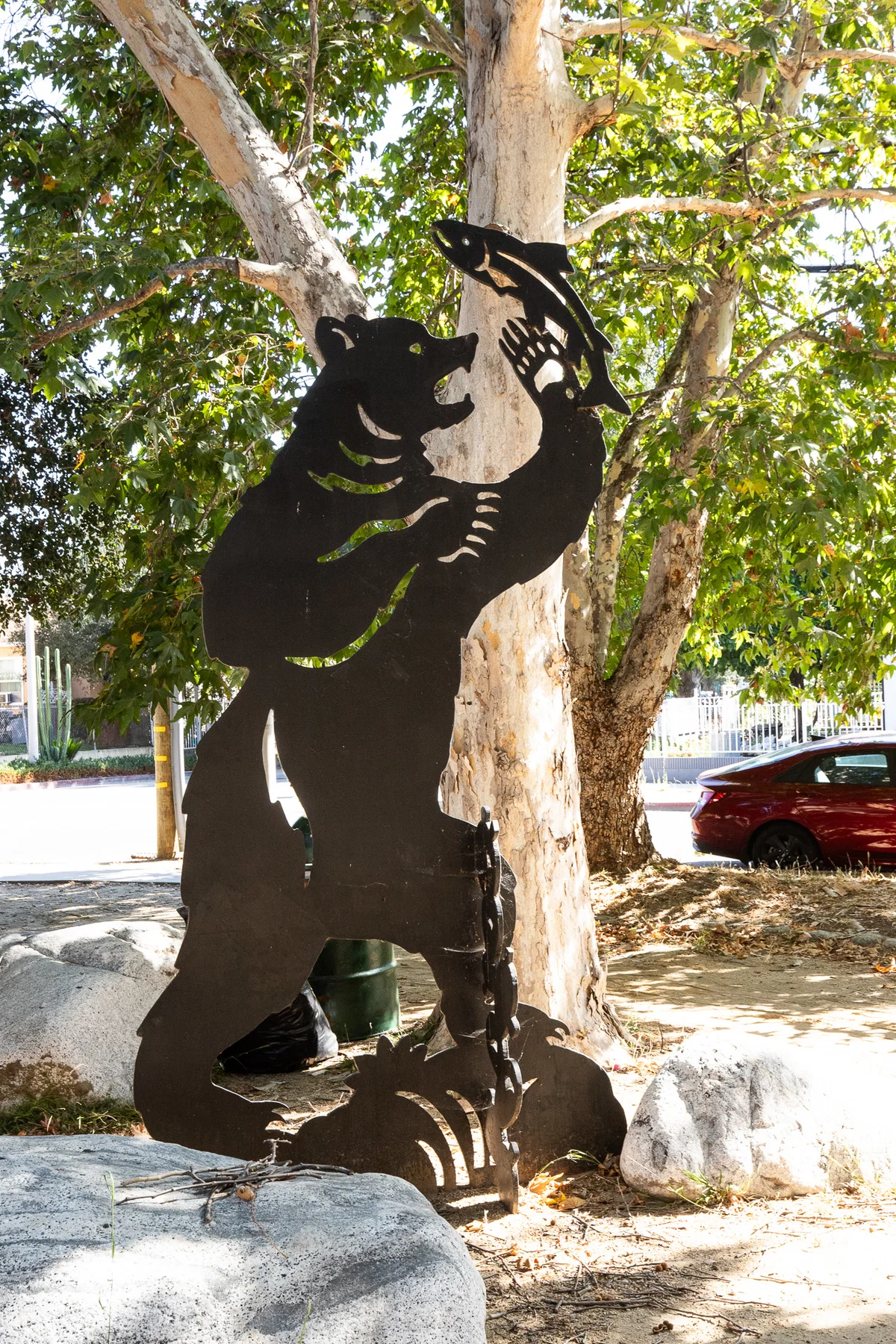
Oso Park is nested within a neighborhood. This is where I really appreciate this kind of small park.
When I lived in Arlington, we had spaces like this all over the place. Not always big activity parks where you could play a full game or spend the whole day, but small community spaces along walks. Places where neighbors could sit, pass through, meet, or hang out for a bit.
Oso Park has sculptures of local animals: bear, deer, mountain lions. It pays respect to the local fauna and to the idea that this river corridor is habitat, even after everything that has been done to it. There are sycamores, shade, landscaping, and places to sit.
From there we walked out toward the river, but we failed to find the actual Steelhead Park.
Oops.
I shall return.
And honestly, that feels fine. The LA River is not something you fully understand in one visit. Missing the park is part of how I experienced the place: confusing, layered, not always well-marked, but still worth coming back to.
Egret Park
Egret Park has a nice gate. I am not sure what these gates are really for, since the wall next to them is only a couple of feet tall. I suppose they are meant to signal whether the walk is open or closed depending on the time of day. Their actual effect as a barrier is pretty minimal.
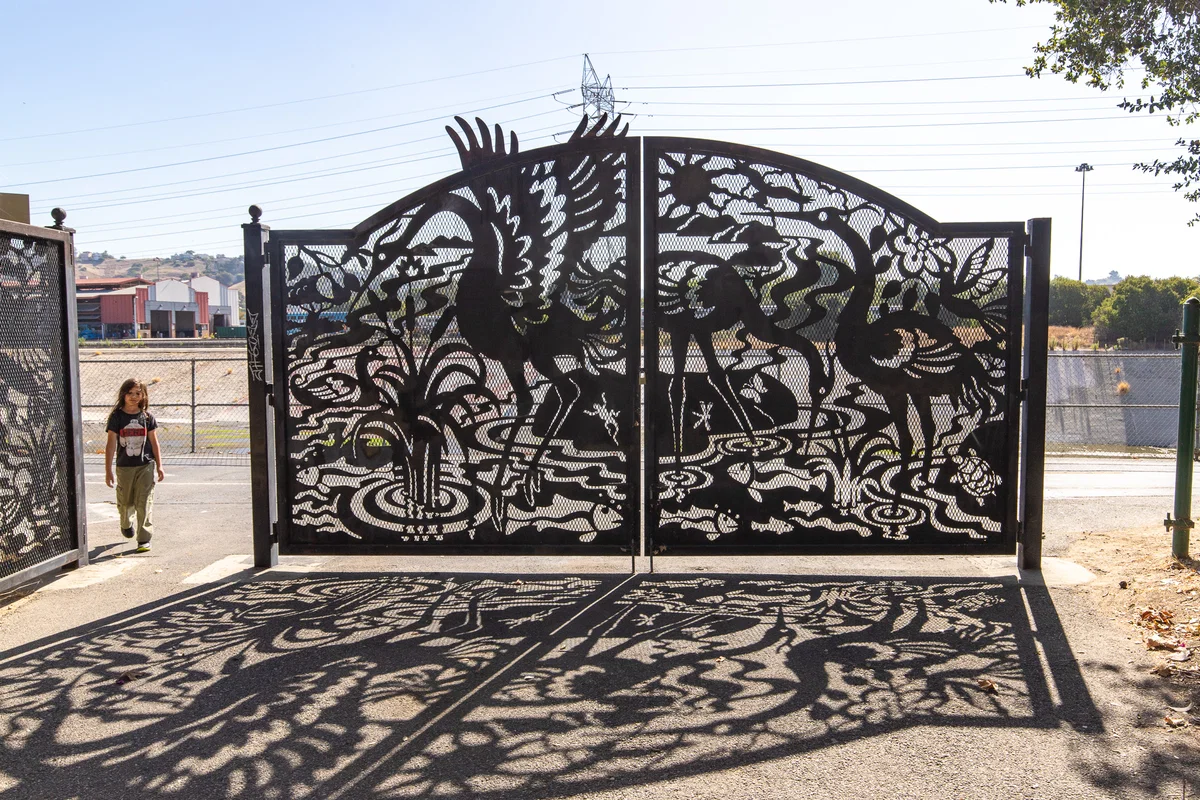
There is not a lot to say about Egret Park as a destination. It is alongside the river, and the name reflects what the park is trying to point your attention toward. Like the other parks, it can be a good place for birdwatching.
I did not carry my large lens because I had my son with me, and photographing birds takes a kind of patience he does not have. But we still saw waterfowl, including ducks with ducklings.
That is one of the quiet successes of these parks. They do not need to be spectacular. Sometimes they just need to get you close enough to notice what is already there.
Lewis MacAdams Riverfront Park / Marsh Park
The final park we visited was Lewis MacAdams Riverfront Park, formerly Marsh Park. This is the most traditional of the parks we visited. If you are looking for a destination park instead of a stop along the riverwalk, this is the one.
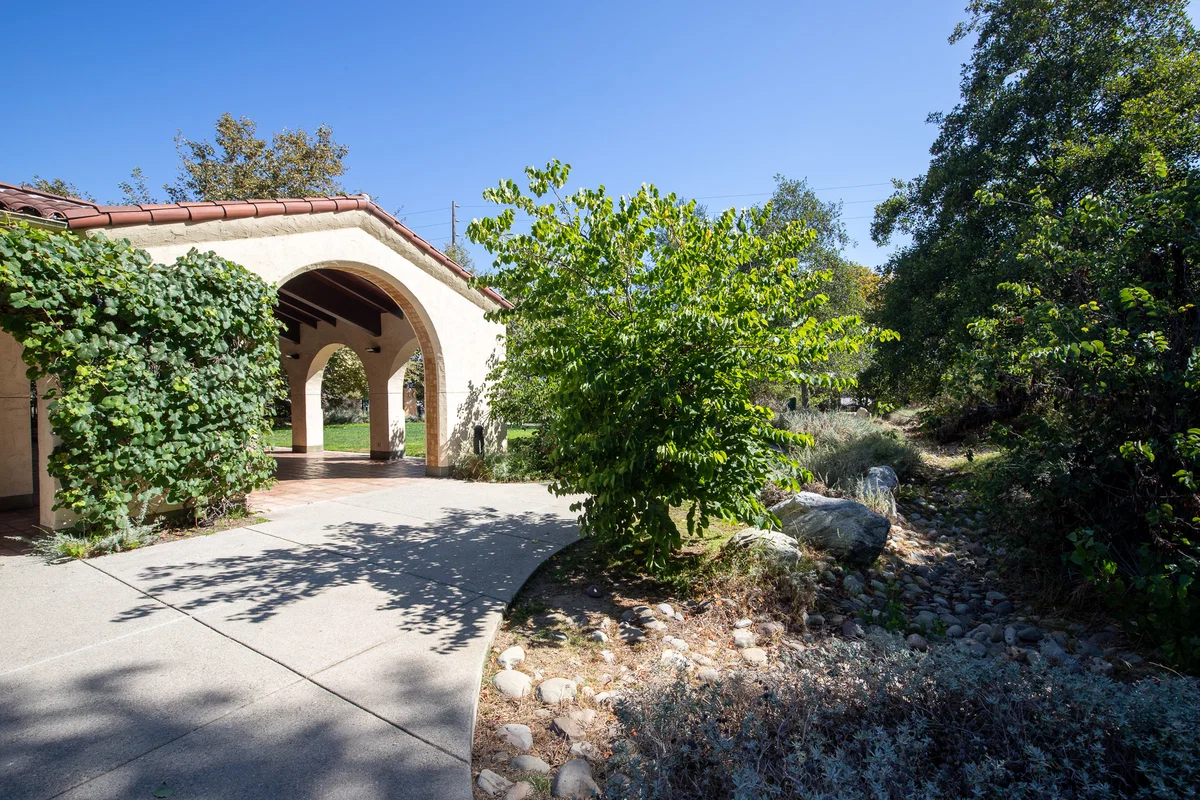
It has recreational facilities, including a skatepark and exercise machines. It has a visitor center and open fields. There is more room to spread out, more shade, and more of the familiar structure of a city park.
But even here, the river complicates the scene.
The park sits in a neighborhood still shaped by industry, private property, river infrastructure, and newer creative businesses. Public restoration does not happen on a blank canvas. It has to fit itself into what already exists: warehouses, roads, old parcels, fences, utilities, and the geometry of the flood-control channel.
That gives the park a strange texture. It is not an escape from the city. It is very much inside the city.
And that is part of why I liked it.
The park does not pretend that the LA River has been returned to wilderness. Instead, it gives people a place to meet the river as it actually exists: engineered, constrained, messy, living, public.
Final Thoughts
I started the morning thinking I was going to visit a series of small parks. By the end, I realized the parks were only part of the story.
The real story is the riverwalk.
The parks are small acts of care along it. Some are worn. Some are confusing. Some need maintenance. Some signs need to be replaced. Some spaces could be better tended, better marked, and better explained.
But none of that cancels the value of the work.
Restoration in Los Angeles is not going to mean simply undoing the city. The river cannot be allowed to flood the way an unchannelized river would. Too many people live and work near it. Too much infrastructure depends on it staying controlled.
But restoration can still mean something.
It can mean access. It can mean shade. It can mean native plants. It can mean bike and walking paths. It can mean a place to sit and watch the river. It can mean bridges for people, not just cars. It can mean signs that tell people what they are looking at, even if those signs now need care themselves. It can mean reminding a city that the river was never just a storm drain.
Public space is never neutral. It carries messages from the people who build it, the people who maintain it, the people who neglect it, and the people who use it.
The graffiti, protest signs, locks, warnings, and worn-out interpretive panels all add other messages. That is not separate from the place. That is the place. People are using this corridor. People are speaking through it.